
Morning coffee and workout supplements are already a part of millions of routines, so combining them seems like the obvious shortcut. The question is whether creatine actually stays effective when added to the coffee, or if heat and caffeine ruin the effect.
The short answer is yes. Creatine monohydrate can safely be mixed into coffee without losing its effectiveness. Research has shown that creatine remains highly stable in warm coffee for the short period most people take it and drink it. In practical terms, that means your morning brew can double as your creatine delivery system.
Why Creatine Coffee Works Best With Consistent Daily Use
For most people, this combination is more than just convenient. Coffee provides caffeine for alertness, focus, and workout energy, while creatine supports ATP production, strength, muscle recovery, and even cognitive performance. One important thing to understand is that creatine works through long-term muscle saturation, not short-term use. Taking it for 10 days, stopping, and then restarting later is far less effective than taking it daily.
That’s why many people like adding creatine to coffee, as it helps in building a routine, as they can take creatine along with their coffee.
Some users also follow a creatine loading phase to saturate muscles faster. A common approach is:
- Loading phase: 10–15g daily for about 5 days
- Maintenance phase: 3–5g daily afterwards
Others skip loading completely and simply take 3–5g every day, which still works well over time, just more gradually.
This guide covers:
- Whether coffee destroys creatine
- Creatine solubility and pH science
- Benefits for athletes, seniors, and vegans
- Risks and side effects
- How to mix it properly
- Three easy recipes that actually taste good
| Benefit | Target Group | Study Outcome |
| Strength Support | Seniors 65+ | Improved lower-body strength |
| Faster Recovery | Athletes | Better post-training recovery |
| Daily Energy Support | Vegans | Helps support lower dietary creatine intake |
Creatine & Coffee Science
Does Coffee Destroy Creatine?
One of the biggest myths online is that caffeine or heat kills creatine. That idea mainly came from the older misunderstanding around creatinine conversion and outdated loading studies.
Modern evidence shows creatine remains largely stable in coffee under normal drinking conditions.
At the average acidity level of coffee, which is around pH 5, creatine degradation is extremely limited during the short time between mixing and drinking. Even warm liquids do not instantly break it down.
The real issue is prolonged exposure to acidic liquid for hours, not the few minutes it sits in your mug.
\Since caffeine affects the body beyond energy alone, it’s also worth understanding its impact on nutrients and stress response. You can read more about it in Does Coffee Decrease Magnesium and Mineral Balance.
Solubility: Why Warm Coffee Works Better
Creatine monohydrate naturally dissolves better in warm liquids than in cold water.
When mixed into hot coffee:
- The powder disperses faster
- Clumping decreases
- Texture improves
- Less sediment settles at the bottom
Micronised creatine works especially well because the particles are smaller and smoother.
Creatine HCL is another option, which mixes very easily in coffee because it has higher water solubility than monohydrate. It usually dissolves faster with less grit, although creatine monohydrate still remains the most researched and cost-effective form.
Avoid boiling temperatures for long periods, but standard brewed coffee temperatures are completely fine.
Heat Stability
In practical terms, creatine loss in typical coffee temperatures is minimal. Most brewed coffee sits between 80–85°C, which is well within safe short-term use conditions.
If you drink your coffee within 20–30 minutes, creatine remains extremely intact.
Creatine and Caffeine Together
A common myth suggests caffeine cancels out creatine’s benefits, but current research does not strongly support that claim for normal daily use.
For most healthy adults, coffee and creatine can be safely combined as part of a regular routine. The biggest factor for creatine effectiveness is consistency, not whether it’s mixed with caffeine.
Many people use the combination simply because it is convenient and easier to maintain long-term.
Benefits of Creatine by Group
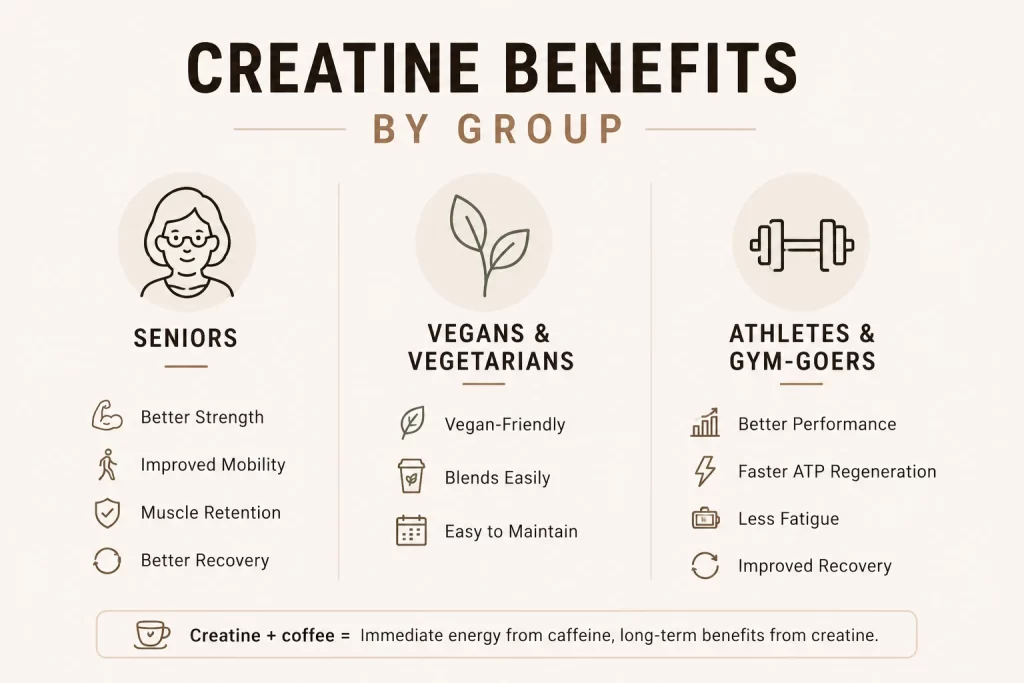
1. Seniors
Creatine may be especially useful for older adults because natural muscle mass and creatine stores decline with age.
Adding creatine to an established habit is usually easier than remembering separate supplements.
Potential benefits include:
- Better lower-body strength
- Improved mobility support
- Support for muscle retention
- Better training recovery
Collagen-based coffee combinations are particularly popular among older adults because they combine protein support with convenience.
2. Vegans and Vegetarians
Plant-based diets contain little to no dietary creatine, which means vegans may respond especially well to supplementation.
Coffee-based oat or almond lattes work well because:
- Creatine itself is vegan-friendly
- Plant protein blends easily with coffee
- Daily use becomes easier to maintain
Many vegan athletes combine creatine with pea protein for a more complete recovery drink.
3.Athletes and Gym-Goers
For active individuals, creatine coffee provides a simple pre-workout combination.
Possible benefits include:
- Better training output
- Faster ATP regeneration
- Reduced fatigue perception
- Improved recovery support
- May help gym-goers push an extra rep or two during intense sets
That extra rep can make a difference over time because progressive overload is one of the key drivers of muscle growth and strength gains. Multiple studies have linked creatine supplementation with improved strength and recovery support.
The caffeine provides immediate stimulation, while creatine works through long-term muscle saturation.
Some people also mix creatine into energy drinks and pre-workout instead of coffee. If you’re deciding between the two, check out coffee vs energy drinks: which is better for energy and performance.
Risks & Solutions
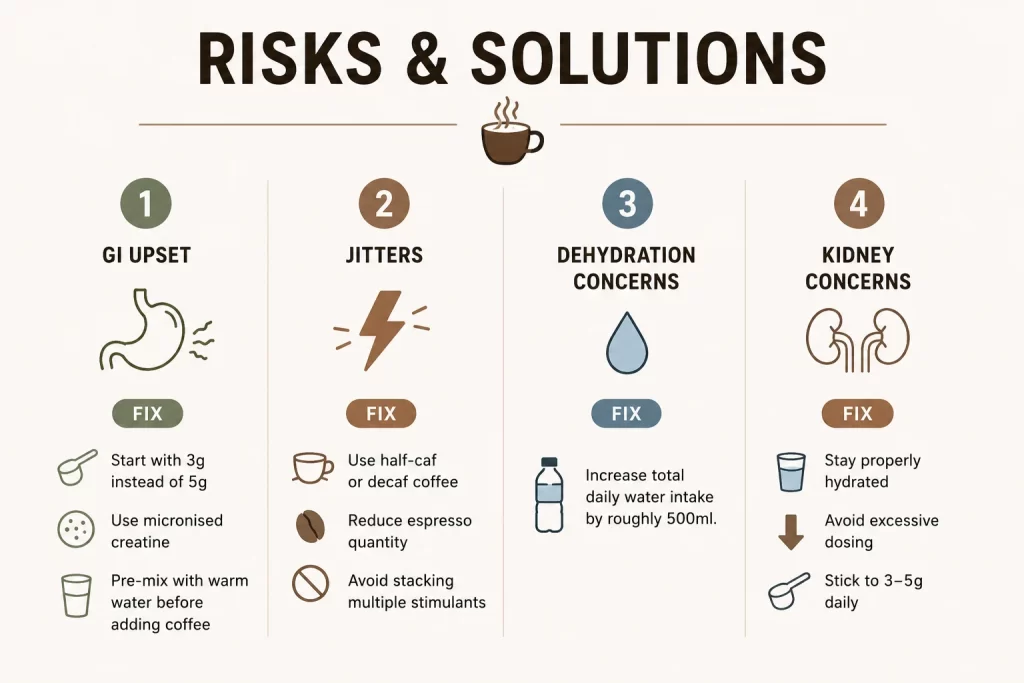
Most people tolerate creatine coffee very well, but a few issues can happen during the adjustment period.
1. GI Upset
Coffee acidity, along with undissolved creatine, can irritate the stomach in sensitive individuals.
Fix
- Start with 3g instead of 5g
- Use micronised creatine
- Pre-mix with warm water before adding coffee
- You can also take creatine HCL if regular monohydrate causes bloating or stomach discomfort,
2. Jitters
Combining high caffeine intake with strong pre-workouts can feel overstimulating.
Fix
- Use half-caf or decaf coffee
- Reduce espresso quantity
- Avoid stacking multiple stimulants
The FDA recommends most healthy adults stay below roughly 400mg of caffeine daily, especially when combining coffee with pre-workouts or energy drinks.
3. Dehydration Concerns
Creatine pulls water into muscle cells, while caffeine has mild diuretic properties in some people.
Fix
Increase total daily water intake by roughly 500ml.
4. Kidney Concerns
People with kidney disease, kidney stones, or existing kidney-related conditions should consult a doctor before taking creatine regularly. Since creatine increases water retention in muscles, proper hydration is important while supplementing.
Fix
- Stay properly hydrated
- Avoid excessive dosing
- Stick to 3–5g daily
| Risk | Cause | Solution |
| GI discomfort | Acid + undissolved powder | Start with 3g |
| Dehydration | Low fluid intake | Drink extra water |
| Gritty texture | Poor dissolving | Use micronised creatine |
| Kidney stress | Existing kidney issues | Consult a doctor |
My Personal Experience With Creatine in Coffee
I’ve personally tried mixing creatine with plain black coffee, and honestly, it slightly ruins the taste. Creatine has a mildly salty and chalky texture, which becomes more noticeable in simple black coffee.
What worked much better for me was adding creatine to a normal milk-based cold coffee or iced coffee with a little ice cream. The creaminess masks the texture and taste almost completely, which makes it much easier to drink daily. Milk balance can dramatically change how coffee tastes and feels. If you want café-style texture, read the latte milk-to-coffee ratio explained.
I also wouldn’t recommend mixing flavoured creatine with coffee. Most flavoured creatine powders clash with coffee’s bitterness and usually create an odd aftertaste.
For regular gym-goers, the best combination can be :
- A decent pre-workout where you add separate creatine, or
- A pre-workout formula that already contains creatine
That setup generally tastes better and works more naturally before training sessions.
For non-gym-goers or casual users, flavoured coffee drinks are usually the better option because they hide the slightly salty taste of creatine.
FAQs
- Is creatine coffee good for weight loss?
Creatine itself does not directly burn fat, but it may help maintain strength and muscle during a calorie deficit, which can support long-term fat loss goals.
- Can you mix creatine with protein coffee?
Yes. Creatine mixes well with protein coffee drinks and is commonly combined with whey or plant protein for recovery support, usually as a post-workout drink
- Does creatine make coffee foam or clump?
Sometimes. Lower-quality creatine can create clumps or sediment, especially in cold drinks. Micronised creatine mixes much more smoothly.
- Should you take creatine on rest days?
Yes. Creatine should be taken daily, even on non-workout days, to maintain muscle saturation levels.
- Can beginners take creatine with coffee?
Absolutely. Beginners can safely combine coffee and creatine, preferably starting with 3g daily to assess tolerance.
Conclusion
Putting creatine in coffee is one of the easiest ways to make supplementation part of a daily routine. The combination works well for gym-goers, athletes, beginners, vegans, and even older adults looking for a simpler way to stay consistent.
The biggest factor is not whether you take creatine in coffee or water, it’s whether you take it consistently. Hot coffee does not meaningfully destroy creatine during normal drinking time, and warm liquids can actually help it dissolve better.
If black coffee affects the taste too much, milk-based or flavoured coffee drinks usually work much better. Micronised creatine or creatine HCL can also improve mixing and reduce grittiness.
Start with 3–5g daily, stay hydrated, and choose a combination that realistically fits your lifestyle long term.