Introduction: Why grinding matters
You are bad at making coffee; your grinder is just dialled wrong.
Grinding is where good coffee either comes alive or completely falls apart it. It controls the extraction [ how flavours are pulled from the beans ], aroma release and ultimately how your coffee tastes in the cup. Even the best beans will taste flat, bitter or sour if the grind size is off.
Here is the part which most of the guides miss, is not just about ‘fine or coarse’.It is influenced by bean density , static , clumping , heat and grinder behaviour . If you ignore those, you will always feel like your coffee is inconsistent.
What kind of grinder should you use?
Burr grinder vs blade grinder
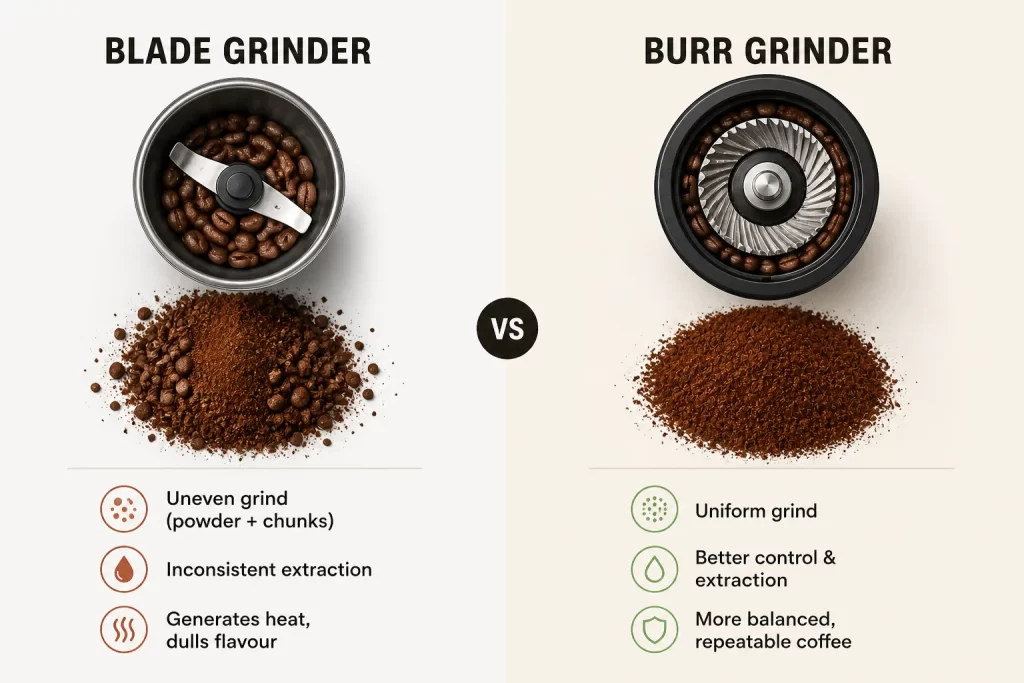
A Blade grinder is cheap and easy to find, but it chops the beans unevenly, which creates a mix of powder and large chunks. This can lead to inconsistent extraction and can generate heat, which dulls out the flavour.
A burr grinder crushes beans into uniform particles, giving better control over the grind size and extraction. It produces more balanced, repeatable coffee, but costs you more and needs regular cleaning.
Reality check: Blade grinders don’t truly grind; they chop randomly. That’s why your coffee tastes quite different every time.
Manual vs electric burr
- Cheaper
- Better control
- Quiet
- Slower
- Fast and convenient
- Better for daily use
- More consistent at scale
- Higher cost
Practical recommendation
For this guide, assume you’re using a burr grinder (manual or electric). It’s the only way to properly dial in grind size and taste.
Choosing and preparing your beans
Roast level & bean behaviour
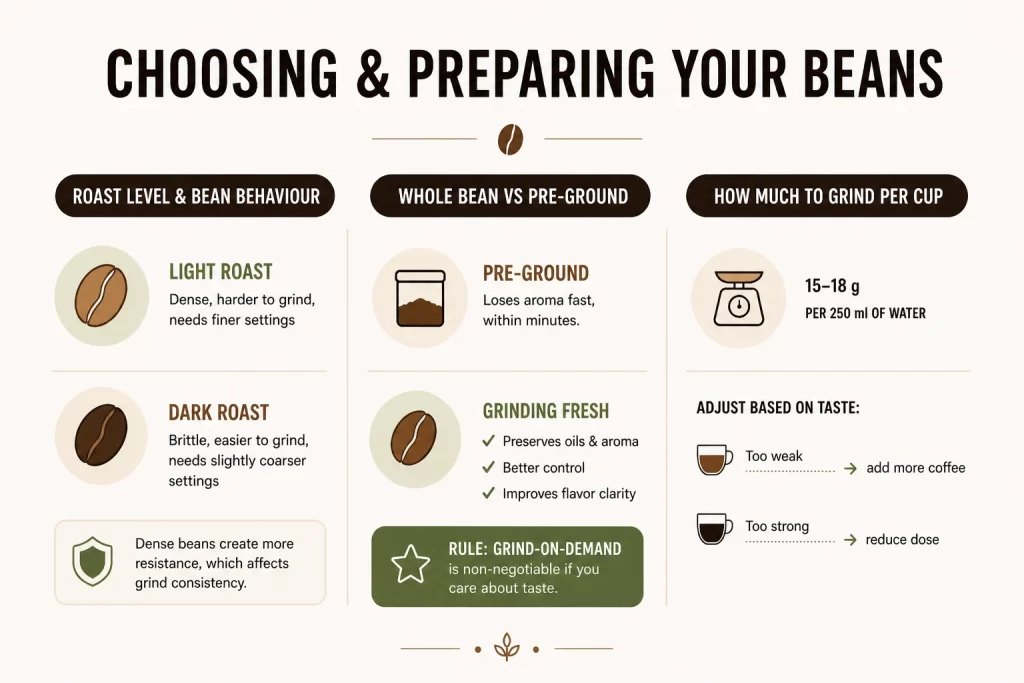
- Light roast: dense, harder to grind, needs finer settings
- Dark roast: brittle, easier to grind, often needs slightly coarser settings
Dense beans create more resistance, which directly affects the consistency of the grind
Whole bean vs pre-ground
Pre-ground coffee loses aroma fast, and sometimes within a few minutes.
Grinding fresh:
- Preserves oils and aroma
- Gives better control
- Improves flavor clarity
Rule: Grind-on-demand is non-negotiable if you care about taste.
How much to grind per cup
Start here:
- 15–18 grams per 250 ml of water
Adjust based on taste:
- Too weak → add more coffee
- Too strong → reduce dose
Coffee grind size chart (by brew method)
| Brew Method | Grind Size | Texture Description | Why It Works |
| French Press | Coarse | Like sea salt | Long steep time needs slower extraction |
| Pour-over (V60) | Medium | Like sand | Balanced flow and extraction |
| Chemex | Medium-coarse | Slightly chunky | A thicker filter slows the flow |
| Drip Coffee | Medium | Smooth sand | Even extraction in the machine |
| AeroPress | Medium-fine | Fine sand | Short brew time needs faster extraction |
| Moka Pot | Fine | Table salt | Pressure brewing needs a tighter grind |
| Espresso | Very fine | Powdery | High pressure, fast extraction |
| Cold Brew | Extra coarse | Chunky | Long soak prevents bitterness |
Different grind sizes are also used for various coffee styles. If you enjoy milk-based drinks, understanding ratios is just as important,check out latte milk-to-coffee ratio explained.
Step-by-step guide to grinding coffee
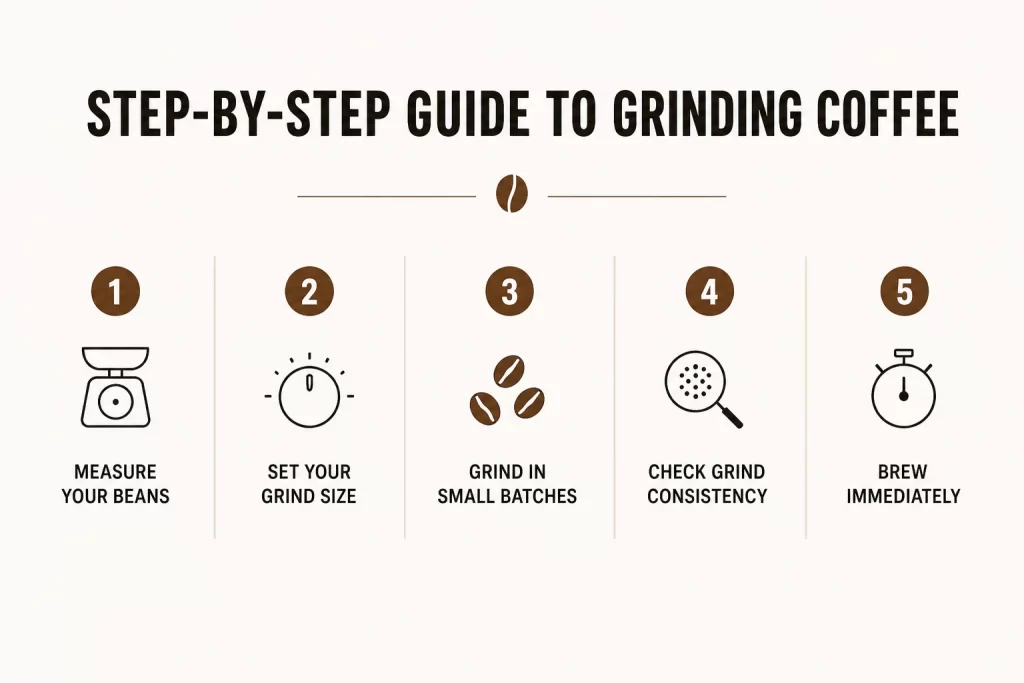
Step 1: Measure your beans
Use a scale. Guessing can lead to inconsistency.
Step 2: Set your grind size
- Coarse = fewer, larger particles
- Fine = tighter, powder-like
Most grinders have a dial, start at the recommended range, then adjust.
Step 3: Grind in small batches
Grinding too much at once:
- Builds heat
- Causes flavor loss
- Increases retention
Keep it fresh, grind only what you need.
Step 4: Check grind consistency
Look for:
- Even particle size
- Minimal dust (fines)
- No large chunks (boulders)
If you see both powder and big chunks → your grind is inconsistent.
Step 5: Brew immediately
Ground coffee oxidises fast.
Waiting even 10–15 minutes reduces aroma and flavour.
How to dial in your grind
This is where most people go wrong; they usually follow charts instead of taste.
Taste-based dialing
- Sour/weak coffee → go finer
- Bitter/harsh coffee → go coarser
Why?
- Fine grind = more extraction
- Coarse grind = less extraction
Quick test method
- Grind
- Brew a small cup
- Taste
- Adjust the grind slightly
- Repeat
This loop is how professionals dial in coffee, not guesswork.
Visual check
- Good grind = uniform particles
- Bad grind = mix of powder + chunks
Blade grinders often create “mixed chunkiness,” which leads to uneven extraction.
Hidden grinding issues
Ever seen the coffee grounds sticking to the container, lid or even flying around?
That’s basically static electricity, which is more common in dry environments or with freshly roasted beans.
Problem:
- Uneven distribution of grounds in your brewer
- Channelling (especially in espresso), leading to poor extraction
Fix:
- Lightly mist beans with a drop of water before grinding (often called the RDT method)
- Use grinders designed with anti-static features
- Tap or shake the grounds container to break clumps before brewing
Heat and burn-in
Grinding creates friction, and friction creates heat, especially in high-speed electric grinders.
Problem:
- Burns off delicate aromatic oils
- Results in flat, dull, or slightly “roasted” tasting coffee
Fix:
- Grind in short bursts instead of long continuous runs
- Avoid overloading the grinder
- Let the grinder cool between batches if making multiple servings
Grind retention & freshness
Even good grinders hold onto small amounts of coffee inside.
Problem:
- Old, stale grounds mix with fresh coffee
- Causes flavour contamination and inconsistency
Fix:
- Tap the grinder gently after each use
- Run a small purge dose if needed
- Clean burrs and chute regularly
How to grind for different setups
Single-serve at home
- Weigh beans every time (consistency matters more than guessing)
- Grind fresh per cup
- Adjust grind size daily depending on taste and humidity
This is where you get the best results with maximum control and minimal waste.
Office or shared grinder
Shared grinders are convenient but usually neglected.
Best practices:
- Avoid filling the hopper with beans (they go stale faster)
- Grind only what you need immediately
- Clean frequently to avoid buildup
Reality: Shared grinders usually produce inconsistent coffee because many people ignore the grind settings and cleaning.
Pre-grinding (when acceptable)
Pre-grinding is not an ideal thing, but it can be practical sometimes.
Acceptable situations:
- Travel
- Cold brew (less sensitive to freshness loss)
Storage tips:
- Use an airtight container
- Store in a cool, dark place
- Consume within 24–48 hours
Common grinding mistakes and fixes
Mistake 1: Using one grind size for all methods
Different brew methods require different extraction speeds.
Fix: Adjust the grind size based on your brewing method.
Mistake 2: Grinding too much at once
Grinding in bulk might be convenient, but it sacrifices flavour.
Fix: Grind only what you need for each brew.
Mistake 3: Ignoring burr wear
Burrs don’t last forever. They dull over a period of time.
Signs of dull burrs:
- Inconsistent grind size
- More fines and boulders
- Coffee tastes flat or lifeless
Fix: Replace burrs periodically based on your usage.
Quick-reference cheat sheets
Grind size by brew method
- French press → coarse
- Pour-over → medium
- Drip → medium
- AeroPress → medium-fine
- Espresso → fine
- Cold brew → extra coarse
Do this / Don’t do this
| Do This | Don’t Do This |
| Use a burr grinder | Use one grind size for all methods |
| Weigh your beans | Store ground coffee long-term |
| Adjust grind based on taste | Ignore grinder maintenance |
| Brew immediately after grinding | Overheat beans while grinding |
FAQs
1. Can I use a blade grinder and still get good coffee?
You can, but the results will be inconsistent. Blade grinders produce uneven particles, which causes both over-extraction (bitterness) and under-extraction (sourness) in the same cup. A burr grinder gives you far better control and consistency.
2. How often should I clean my coffee grinder?
Light cleaning once a week and a deeper clean every 2–4 weeks works well for most users. If you switch beans often or notice stale flavours, increase cleaning frequency.
3. What grind size is best for beginners?
Start with a medium grind. It’s the most forgiving and works across common brewing methods such as drip machines and basic pour-over. From there, adjust based on taste.
4. Why does my coffee taste different even with the same beans?
Because your grind isn’t consistent, small changes in grind size, uneven particles, or leftover stale grounds in the grinder can all affect extraction. Even humidity and bean freshness play a role. If your taste varies, check your grind setting, clean your grinder, and dial in again.
Final takeaway
Great coffee isn’t about expensive beans or fancy equipment; it’s more about control. And that control starts with your grind. From choosing a burr grinder to dialling in size based on taste, every small adjustment shapes your final cup. Master the grind, and everything else, such as flavour, balance, and consistency, will eventually fall into place.