
Coffee is one of the most enjoyed beverages worldwide, but for many people, it comes with a downside, which is acidity. That sharp, sometimes harsh edge can lead to discomfort, especially if you are prone to acid reflux, bloating, or general stomach sensitivity.
The important thing most guides miss is this: the coffee acidity is not just about taste, it is influenced by the chemistry of brewing technique, and your own physiology. That’s why two people can have the same coffee and have totally different experiences.
The good news is that you don’t have to quit coffee. With a few targeted changes, you can easily make your cup smoother and make it easier to tolerate for your stomach.
This guide covers science-backed explanations, practical brewing adjustments and real-world habits which help in reducing acidity without losing the flavour.
What Makes Coffee Acidic?
Flavour Acidity vs Stomach Irritation
In coffee, “acidity” can mean two different things:
- Flavour acidity → bright, crisp, fruity notes (often desirable)
- Stomach acidity → irritation, reflux, or discomfort
These are not the same. A coffee can taste strong but still be gentle on the stomach or taste dull yet trigger irritation, depending on how you prepare it.
The Chemistry Behind the Coffee Acid
Coffee contains several organic acids, including :
- Chlorogenic acids (major contributor)
- Citric acid (fruity brightness)
- Malic acid (apple-like sharpness)
During the roasting process, chlorogenic acids break down into quinic and caffeic acids, which can influence the bitterness and perceived hardness. Darker roasts reduce the overall acid content, but they can increase certain bitter compounds.
Another important distinction is pH vs perceived acidity. Coffee usually has a pH around 4.5–5, but how acidic it feels depends more on its chemical composition and concentration than pH alone.
Water composition also matters. Minerals such as calcium and magnesium can buffer acidity, slightly reducing how sharp the coffee tastes.
Factors That Affect Acidity
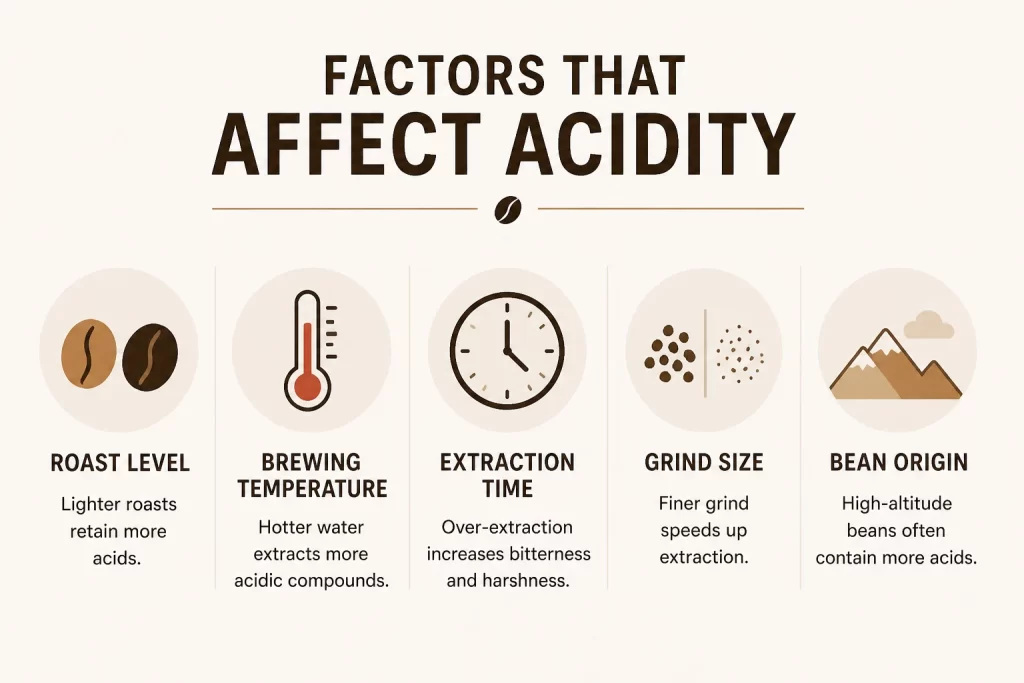
Several controllable factors determine how acidic your coffee turns out:
- Roast level – lighter roasts retain more acids
- Brewing temperature – hotter water extracts more acidic compounds
- Extraction time – over-extraction increases bitterness and harshness
- Grind size – finer grind speeds up extraction
- Bean origin – high-altitude beans often contain more acids
The key takeaway: acidity is not fixed -it is adjustable
Why Coffee Can Upset Your Stomach
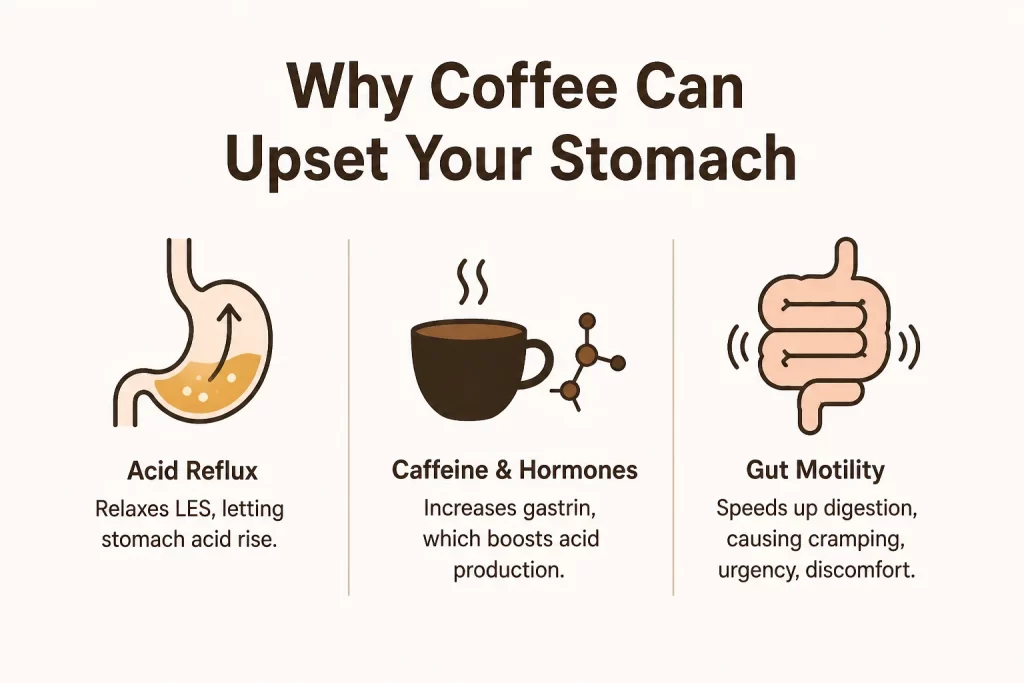
Coffee and Acid Reflux
Coffee can relax the lower esophagael sphincter [LES], which allows the stomach acid to travel upwards. This is a primary trigger for reflux symptoms such as heartburn.
The Role of Caffeine and Hormones
Caffeine doesn’t just stimulate alertness; it also increases the release of gastrin, a hormone which triggers the production of stomach acid. This can make the stomach environment more aggressive, especially in sensitive individuals.
Gut Motility and Sensitivity
Coffee can increase gut motility, meaning it speeds up digestion. While this can be helpful for some, it can also lead to:
- Cramping
- Urgency
- Discomfort
For people with mild sensitivity, this is manageable. For those with GERD (gastroesophageal reflux disease), symptoms can be more pronounced and consistent.
Why Hot, Strong Coffee Feels Worse
Two factors amplify irritation:
- Temperature – very hot liquids can irritate the stomach lining
- Strength – higher concentration increases acid load
Together, they make coffee feel significantly harsher than necessary.
10 Ways to Make Coffee Less Acidic
1. Choose a Darker Roast
Dark roasting breaks down chlorogenic acids, which are one of the main contributors to the acidity of the coffee. As roasting progresses, these acids degrade into compounds which taste less sharp.
This leads to:
- Lower overall acid content
- Smoother, fuller body
- Better tolerance for sensitive stomachs
While dark roasts can taste more bitter or smoky, they are generally much easier to digest than light roasts.
2. Try Cold Brew
Cold brew is one of the most effective ways to reduce acidity in coffee.
Because it uses cold water over a long steeping time, it extracts fewer acidic compounds. This happens due to the lower solubility of acids at cooler temperatures, while still extracting caffeine and flavour.
Additional benefits:
- Naturally smoother taste
- Lower perceived bitterness
- Can be diluted to further reduce intensity
If acidity is your main issue, this is usually the first method to try.
3. Use a Paper Filter
Paper filters remove oils and fine particles, including compounds such as cafestol and kahewol, which can contribute to digestive discomfort for some people.
Compared to metal filters, paper filters:
- Produce a cleaner cup
- Reduce sediment
- Lower irritation potential
This is a simple switch which can make a noticeable difference without changing your coffee type.
4. Lower the Brewing Temperature
Brewing coffee water that’s too hot [ near boiling ] increases the extraction of both the acids and bitter compounds.
The ideal range is:
- 90–96°C for most methods
Lower temperatures:
- Reduce harshness
- Improve balance
- Prevent over-extraction
Even a small drop in temperature can noticeably smooth out your coffee.
5. Use a Coarser Grind
Grind size directly affects how quickly compounds are extracted.
A coarser grind:
- Slows down extraction
- Reduces the release of acidic compounds
- Prevents over-extraction
This works especially well with immersion methods such as French press and cold brew, which involve longer contact times.
6. Avoid Over-Extraction
Over-extraction is one of the most common causes of harsh, acidic-tasting coffee.
It happens when:
- Brew time is too long
- The grind is too fine
- The water flow is too slow
This pulls out:
- Bitter compounds
- Excess acids
- Astringent flavors
Sticking to proper brew ratios and timing helps maintain a smoother, more balanced cup.
7. Drink Coffee After Food
Drinking coffee on an empty stomach increases the impact of acidity because there’s no buffer.
Food helps by:
- Slowing acid absorption
- Protecting the stomach lining
- Reducing irritation
Even a small meal or snack before coffee can make a major difference in how it feels.
8. Add Milk or a Milk Alternative
Milk helps reduce the perceived acidity by softening the flavour and slightly buffering the drink.
Why it works:
- Proteins bind with some acidic compounds
- Fats create a smoother mouthfeel
- Dilution lowers concentration
Options such as oat milk or almond milk can also help, though dairy tends to have a stronger buffering effect.
9. Try Low-Acid Beans
Some coffees are naturally lower in acid due to how and where they’re grown.
Factors include:
- Lower altitude beans → less acid development
- Brazilian or Sumatran origins → typically smoother profiles
- Natural processing → lower perceived acidity
You can also find blends specifically marketed as “low-acid,” which are designed for – drinkers with sensitive stomachs.
Best Coffee Types for Sensitive Stomachs
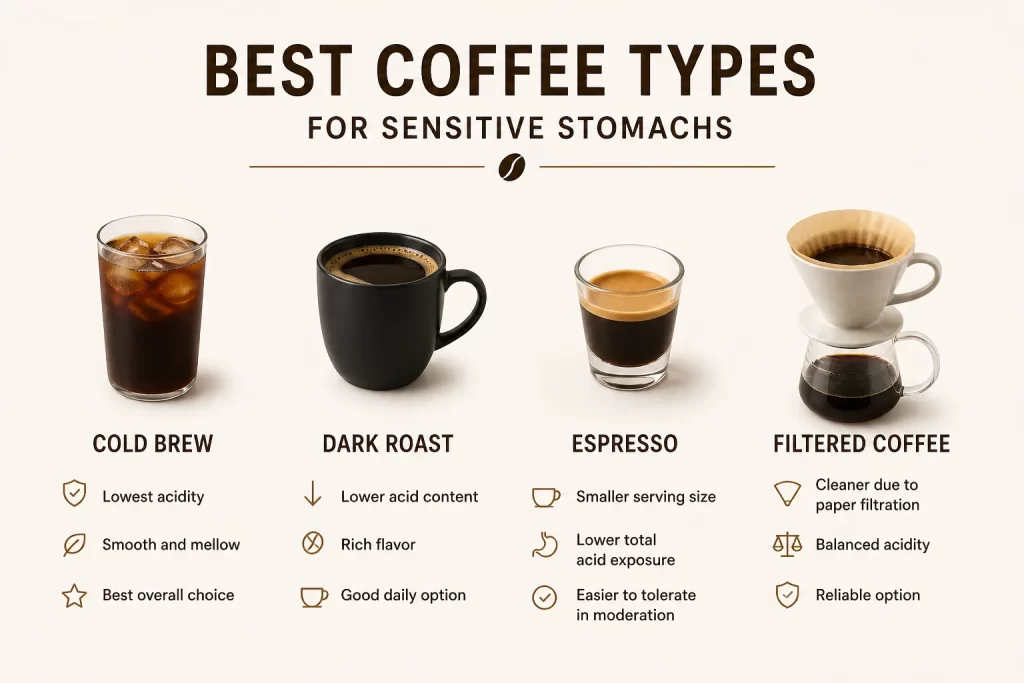
Cold Brew
- Lowest acidity
- Smooth and mellow
- Best overall choice
Dark Roast
- Lower acid content
- Rich flavor
- Good daily option
Espresso
- Smaller serving size
- Lower total acid exposure
- Easier to tolerate in moderation
Filtered Coffee
- Cleaner due to paper filtration
- Balanced acidity
- Reliable option
Which One Is Easiest to Tolerate?
For most people:
- Cold brew
- Dark roast
- Espresso (small servings)
Cold brew consistently ranks as the most stomach-friendly.
What to Avoid If You Want Less Acid
- Light roasts – higher acid retention
- Boiling water – over-extraction
- Large quantities quickly increased the acid load
- Empty stomach consumption – higher irritation risk
- Very strong brews – concentrated acidity
Avoiding these can make a noticeable difference.
Quick Comparison Table
| Method | Effect on Acidity | Ease | Best For | Taste Impact |
| Cold brew | Very low | Medium | Sensitive stomach | Smooth, mellow |
| Dark roast | Low | Easy | Daily use | Bold, less bright |
| Paper filter | Moderate | Easy | Cleaner cup | Light body |
| Lower temp brew | Moderate | Easy | Balanced flavor | Smooth |
| Milk added | Mild | Very easy | Quick fix | Creamy |
Step-by-Step Brewing Guide
Beginner Low-Acid Method (Drip Coffee)
- Coffee ratio: 1:15 (coffee to water)
- Grind: medium-coarse
- Temperature: ~92°C
- Brew time: 3–4 minutes
Steps:
- Add ground coffee to a paper filter
- Pour water slowly in stages
- Avoid over-saturating
- Serve after brewing completes
Maximum Acidity Reduction (Cold Brew)
- Ratio: 1:4 concentrate (dilute later)
- Grind: coarse
- Time: 12–18 hours
Steps:
- Mix coffee and cold water
- Steep in fridge or room temp
- Strain through a paper filter
- Dilute 1:1 before drinking
Best Method for Flavour Balance
- Medium-dark roast
- Controlled temperature
- Proper timing
- Optional milk addition
This balances taste and comfort.
Bean Origin and Acidity (Underrated Factor)
Bean origin plays a major role:
- High-altitude (Ethiopia, Kenya) → more acidic, fruity
- Medium-altitude (Colombia) → balanced
- Low-altitude (Brazil) → lower acidity, nutty
Processing also matters:
- Washed coffee → cleaner, brighter acidity
- Natural processed → smoother, heavier body
If you’re sensitive, choose low-altitude, natural-processed beans.
FAQs
1. Does water quality affect how acidic coffee tastes?
Yes. Minerals such as calcium and magnesium can buffer acidity and change how coffee extracts. Hard water may make coffee taste smoother, while very soft or filtered water can make acidity more noticeable. Using balanced filtered water usually gives the best results.
2. Can decaf coffee be less acidic than regular coffee?
Decaf isn’t always lower in acid, but it can feel gentler. That’s because it has less caffeine, which reduces the stomach acid stimulation. For some people, this makes decaf easier to tolerate, even if the acidity level is similar.
3. Does storing coffee incorrectly make it taste more acidic?
Yes. Exposure to air, light, and moisture causes oxidation, which can lead to sour or harsh flavours. Store coffee in an airtight container in a cool, dark place to maintain a smoother taste.
4. Does brewing method matter more than the beans?
Often, yes. The same beans can taste very different depending on how they’re brewed. For example, pour-over can highlight acidity, while cold brew reduces it significantly due to slower extraction.
5. Can your body get used to coffee over time?
Sometimes. Gradually drinking coffee may improve tolerance, but it doesn’t work for everyone. If you’re sensitive, it’s more effective to adjust brewing methods and timing rather than relying on adaptation.
Expert Note / Safety Note
Coffee sensitivity varies significantly between individuals. While these methods can reduce acidity, they may not eliminate symptoms for everyone.
If you experience persistent reflux, stomach pain, or digestive issues, you should consult a qualified healthcare professional. This guide is meant to support better habits, not replace any medical advice.
Conclusion
Making coffee less acidic doesn’t require giving it up; it just requires you to make smarter choices.
The most effective changes are:
- Switch to cold brew
- Use a dark roast
- Brew with a paper filter
From there, adjust grind size, temperature, and timing to suit your preference. With the right approach, you can turn coffee into a smoother, more enjoyable experience without the discomfort.